There are no items in your cart
Add More
Add More
| Item Details | Price | ||
|---|---|---|---|
Chem 13 News Exam Contest Scholarship Preparation Course
Mon Dec 22, 2025
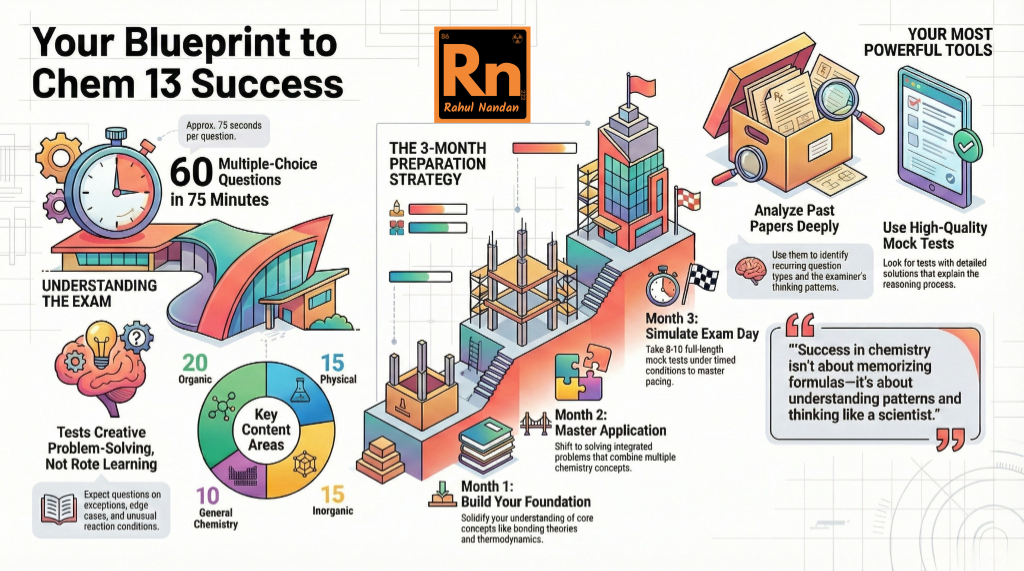
"Success in chemistry isn't about memorizing formulas—it's about understanding patterns and thinking like a scientist." —
This principle has guided my two decades of teaching students for competitive exams, and it holds especially true for the Chem 13 News Exam Contest.
The Chem 13 News Exam represents something different from your typical chemistry test. When students walk into this contest, they're not just answering questions. They're solving puzzles that demand creative thinking alongside solid fundamentals. Over my years preparing students for JEE Mains and other competitive exams, I've noticed that contests like Chem 13 challenge students in ways that actually make them better problem-solvers.
This exam comes from the University of Waterloo's chemistry department. It tests high school students across North America, though participants join from around the world. What makes this contest stand out? The questions push you to apply concepts rather than regurgitate them. Students who perform well often secure scholarships and recognition that strengthen their university applications considerably.
Let me share something from my experience. Back in 2019, one of my students, Priya, participated in this contest without much expectation. She scored in the top percentile and received a scholarship offer worth $15,000 from a Canadian university. That single exam changed her academic trajectory.
The contest serves multiple purposes. First, it gives you a realistic assessment of where you stand compared to peers globally. Unlike school exams that vary wildly in difficulty, this contest maintains consistent standards. Second, universities notice your performance here. Admission committees recognize Chem 13 participants as students who go beyond their curriculum.
From a practical standpoint, preparing for this exam sharpens your analytical skills. The questions require you to connect different chemistry concepts, much like JEE Mains does but with a unique flavor. Students often tell me that their school chemistry became easier after training for Chem 13 because they developed deeper conceptual clarity.
The scholarship opportunities are real. Various universities in Canada and the United States offer awards based on contest performance. Beyond monetary benefits, listing this contest on your application demonstrates initiative and academic curiosity—qualities that admission officers value highly.
The exam runs for 75 minutes. You'll face 60 multiple-choice questions covering all major chemistry areas. The distribution roughly breaks down as: 20 questions on organic chemistry, 15 on physical chemistry, 15 on inorganic chemistry, and 10 on general chemistry concepts including problem-solving applications.
Here's what catches students off-guard: the questions don't follow textbook patterns. Instead of straightforward calculations, you might get a question that asks you to predict reaction outcomes under unusual conditions or explain why a certain molecular structure behaves unexpectedly. The exam tests whether you understand chemistry or just know procedures.
Time management becomes critical. With 75 minutes for 60 questions, you have about 75 seconds per question. Some questions take 30 seconds, others need three minutes of careful analysis. During my coaching sessions, I've watched students struggle not because they lack knowledge but because they get stuck on difficult questions instead of moving forward strategically.
The marking scheme includes negative marking in some versions, though this varies by year. Always check the current year's guidelines before the exam. Questions carry equal weight, so strategic attempts matter more than trying every single question.
One pattern I've observed: the exam loves testing exceptions and edge cases. You might know that most reactions follow a rule, but Chem 13 will ask about the situations where that rule breaks down. This tests genuine understanding versus memorization.
Start by diagnosing your weak areas. Take a diagnostic test covering all chemistry topics. I've found that students often overestimate their organic chemistry skills and underestimate their gaps in physical chemistry concepts like thermodynamics and equilibrium.
Create a study schedule that spans at least three months before the contest. The first month should focus on completing your conceptual foundation. If you're unclear about electron configurations or bonding theories, fix that first. Everything else builds on these basics.
The second month is where you shift gears. Start working on application-based problems. Look for questions that require you to use multiple concepts together. For example, a problem might ask you to predict reaction feasibility using both thermodynamics and kinetics principles. These integrated questions form the core of Chem 13.
In the final month, transition to full-length practice tests under timed conditions. This phase reveals your true preparation level. One student I coached, Rahul, was consistently scoring 85% in practice but performing poorly in timed tests. We discovered he was spending too much time on organic mechanism questions. After adjusting his approach, his scores improved dramatically.
Pay special attention to topics that rarely appear in school exams but show up in Chem 13. These include molecular symmetry, crystal field theory applications, and advanced organic synthesis strategies. Many students ignore these thinking they're too advanced, but they're actually quite manageable with focused study.
Mock tests do more than measure your knowledge. They train your brain to perform under pressure. The psychological aspect of exam preparation is something I emphasize repeatedly with my students. You can know every concept perfectly but still underperform if you haven't practiced working within time constraints.
Take at least eight to ten full-length mock tests before the actual contest. Space them evenly across your preparation timeline. After each mock, spend double the time analyzing it. Don't just check which answers were wrong—understand why you made those mistakes. Was it a conceptual gap? A calculation error? Poor time management?
I recommend taking mock tests at the same time of day as your actual exam. Your brain performs differently at 9 AM versus 4 PM. Training your peak performance for the exact exam time gives you a subtle but real advantage.
One technique that works well: after completing a mock test, wait a day before reviewing it. Then attempt the same test again without looking at answers. This spaced repetition strengthens your neural pathways for problem-solving patterns.
Past papers are gold mines that many students underutilize. Each past paper reveals the examiner's thinking patterns. After analyzing 15 years of Chem 13 papers, I've identified recurring question types and concepts that appear regularly.
When working through past papers, treat them like treasure maps. Notice which topics appear frequently. For instance, questions about reaction mechanisms and energetics show up almost every year, while questions about specific organic compound properties vary more.
Don't just solve past papers—study them. Look at how questions are worded. The exam often includes subtle clues in question stems that point toward the correct answer. Learning to spot these clues comes from exposure to many past questions.
A common mistake: students solve past papers once and move on. Instead, create a question bank from difficult problems across multiple years. Revisit these challenging questions every two weeks. This repeated exposure helps you internalize problem-solving approaches.
Past papers also help you calibrate your difficulty expectations. The actual exam won't feel overwhelming if you've already wrestled with similar questions during practice. Psychological preparation through past papers is just as valuable as the knowledge reinforcement they provide.
Quality mock tests replicate the actual exam environment closely. They should include the same question distribution: heavy emphasis on organic and physical chemistry, with significant representation from inorganic concepts.
The difficulty curve matters too. Well-designed mocks place easier questions at the beginning and gradually increase difficulty, with a few exceptionally challenging problems scattered throughout. This mirrors the actual Chem 13 pattern and helps you develop pacing instincts.
Look for mocks that include detailed solutions, not just answer keys. A good solution explains the reasoning process, highlights common pitfalls, and sometimes offers multiple solving approaches. This educational value transforms mock tests from assessment tools into learning resources.
Computer-based testing mode is increasingly important. If your exam will be computer-based, practice exclusively on computer-based mocks for at least the final month. The experience differs significantly from paper-based tests—everything from marking answers to moving between questions requires adjustment.
The Rahulnandan.com platform offers several advantages for Chem 13 preparation. The computer-based testing mode simulates actual exam conditions accurately. You get immediate feedback on performance, with detailed analytics showing your strengths and weak areas across different chemistry topics.
The platform's past papers collection spans multiple years, giving you comprehensive exposure to question variations. Each paper includes complete solutions with step-by-step explanations. This matters because understanding the solution process is more valuable than knowing the final answer.
The mock test series is designed with progressive difficulty. Early mocks focus on building confidence and identifying gaps, while later mocks challenge you with competition-level questions. This structured progression prevents both overconfidence and discouragement during preparation.
Performance tracking features let you monitor improvement over time. You can see metrics like average solving time per question type, accuracy in different topics, and comparison with peer performance. These insights help you adjust your preparation strategy based on data rather than guesswork.
The mobile app accessibility means you can practice anywhere. Short study sessions during commutes or breaks become productive when you have quality practice material always available. This flexibility helps students who balance school, exam preparation, and other commitments.
Not all mock tests serve your preparation equally. Here are parameters I use when recommending test series to my students:
Question quality tops the list. Questions should require thinking, not just formula application. Avoid test series where questions feel repetitive or overly formulaic. Good questions teach you something new even when you answer them correctly.
Solution explanations must be comprehensive. A brief answer key provides minimal learning value. Look for solutions that explain the concept being tested, walk through the solving process, show where students typically make mistakes, and sometimes offer alternative approaches.
Difficulty alignment with the actual exam is crucial. Some test series are unrealistically easy, giving false confidence. Others are unnecessarily difficult, causing discouragement. The right balance challenges you appropriately while building confidence gradually.
Check if the platform offers performance analytics. Basic mock tests just give you a score. Advanced platforms analyze your performance across topics, question types, and difficulty levels. These insights guide your remaining preparation focus.
User interface quality matters more than you might think. Clunky interfaces distract you from focusing on questions. Smooth, intuitive platforms let you concentrate entirely on problem-solving, which better simulates exam conditions. Chem 13 News Exam Contest Scholarship Prep Course offers 10 past year papers and 1o most expected mocks. all the test will be CBT (Computer Based Test) Mode Online.
The enrollment process is straightforward. Visit Rahulnandan.com and navigate to the Chem 13 News Exam Contest section. You'll find multiple packages offering different numbers of mock tests and access durations.
Select a package based on how much time you have before the exam. If you're starting three months early, the comprehensive package with 15 mock tests makes sense. If you have just a month, the intensive package with 8 focused mocks works better.
After selecting your package, complete the registration by providing basic details. Payment options include various methods for convenience. Once enrolled, you immediately get access to the complete study material, including past papers and the first mock test.
The platform walks you through an orientation test first. This helps you familiarize yourself with the interface before taking actual mock tests. Spend time on this orientation—knowing how to navigate efficiently during the real test saves valuable seconds.
Download the mobile app for on-the-go practice. Your account syncs across devices, so you can start a test on your computer and continue on your phone. This flexibility helps you maintain consistent practice even during busy weeks.
When should I start preparing for Chem 13?
Begin at least three to four months before the contest. This timeline allows you to strengthen fundamentals, practice extensively, and take multiple mock tests without rushing.
Can I prepare for Chem 13 alongside JEE Mains preparation?
Absolutely. The two exams have significant overlap in chemistry concepts. Preparing for Chem 13 actually strengthens your JEE chemistry by developing deeper problem-solving skills.
How many mock tests should I take?
Aim for eight to ten full-length mocks minimum. Quality matters more than quantity—thoroughly analyze each mock rather than rushing through many without proper review.
What if I'm weak in organic chemistry?
Dedicate extra time to mechanism understanding rather than memorization. Organic chemistry in Chem 13 tests your ability to predict and explain, not your memory of specific reactions.
Are calculators allowed in the exam?
Check the current year's regulations. Rules sometimes change, but generally, basic scientific calculators are permitted while programmable or graphing calculators are not.
How important is speed in this exam?
Very important. You need to balance accuracy with speed. Practice identifying which questions deserve more time and which you should answer quickly and move forward.
Should I attempt all questions?
Depend on whether negative marking applies. If there's negative marking, attempt only questions where you can eliminate at least two options confidently. Without negative marking, attempt everything after completing questions you're sure about.
What topics are most frequently tested?
Organic mechanisms, thermodynamics, chemical equilibrium, and periodic trends appear regularly. However, don't ignore other topics—the exam tests comprehensive chemistry knowledge.
How do I improve my problem-solving speed?
Practice timed questions daily. Set a timer for 75 seconds per question during practice. Gradually, your brain develops pattern recognition that speeds up solving time naturally.
What should I do in the final week before the exam?
Take one final mock test, then shift to revision mode. Review your error log from previous mocks, skim through important formulas and concepts, and ensure you're mentally fresh rather than exhausted from last-minute cramming.
"The beautiful thing about learning is that no one can take it away from you." — B.B. King's words remind us that the real victory isn't just the scholarship or recognition, though those are wonderful. It's the chemistry knowledge and problem-solving ability you develop through this preparation.
The Chem 13 News Exam Contest challenges you to think beyond formulas and facts. It asks you to become a chemist, not just a chemistry student. Through systematic preparation using quality resources like those on Rahulnandan.com, combined with dedicated practice and honest self-assessment, you position yourself not just for success in this contest but for excellence in your entire chemistry journey.
Remember that preparation is personal. Some students need more time on physical chemistry, others on organic. Use mock tests to identify your specific needs, then address them strategically. The students who succeed aren't necessarily the ones with the highest IQs—they're the ones who prepare most intelligently.
Start today. Download that first mock test, attempt it honestly, analyze your performance, and build your preparation from there. The scholarship and recognition are waiting, but more importantly, the deeper understanding of chemistry that will serve you throughout your academic and professional life is within reach. Make the commitment, follow through consistently, and watch yourself transform from a student who knows chemistry to one who truly understands it.
Rahul Nandan
Chemistry Expert 🧪| Mentor to Top IIT-JEE, NEET, & Olympiad Achievers 🏆 | Facilitated admissions to MIT, IITs, AIIMS 🎓 | Toastmaster 🎤 | Warren Buffet Enthusiast 💼 | Orator 🗣️ | Music Aficionados🎵
 Launch your Graphy